
By Susan Bunce, Registered Osteopath and Practice Principal at Broadwater Osteopathic Practice
Last updated: August 2026
You spend all year looking forward to your summer break. You pack your bags, head down to Worthing seafront, plan a walk across Cissbury Ring or Highdown Gardens, or book a city break you’ve been talking about for months.
Three days later you swing your legs out of bed, put your foot on the floor…
…and wince. Your heel suddenly hurts.
By the end of the week your calf feels tight, and somehow your lower back has joined in too.
What happened?
“One of the questions I’m asked every summer is, ‘Why has this happened so suddenly?'” says Sue Bunce, Principal Osteopath at Broadwater Osteopathic Practice. “The answer is that, in most cases, it hasn’t happened suddenly at all. The tissues in your feet have usually been working harder for several days before they finally start to complain.”
Summer is consistently one of our busiest times of year for foot and heel pain, and it’s rarely caused by a single bad step. Here’s what’s actually happening to your body, why your footwear plays a role, and how to get relief.
Why Do My Feet Hurt After Holiday Walks?
During summer, most of us change four things without really noticing.
We suddenly walk much more: Doubling or even tripling our daily walking distance exploring holiday towns, parks, or coastal trails.
We walk on unyielding surfaces: Spending hours on concrete promenades, cobblestones, marble airport floors, or pebble beaches like Goring Gap.
We change our shoes overnight: Swapping supportive trainers for lightweight sandals, sliders or flip-flops.
We stand for longer periods: Attending summer events, outdoor pubs, family BBQs, or waiting in long travel queues.
“It’s rarely just ‘wearing bad shoes’ that causes the problem,” Sue explains. “It’s the sudden combination of different footwear, harder surfaces, and walking far more than usual, all at once. Your body is being asked to adapt more quickly than it’s used to.”
How Foot Fatigue Can Lead to Knee, Hip and Back Pain
Your feet are the body’s natural shock absorbers.
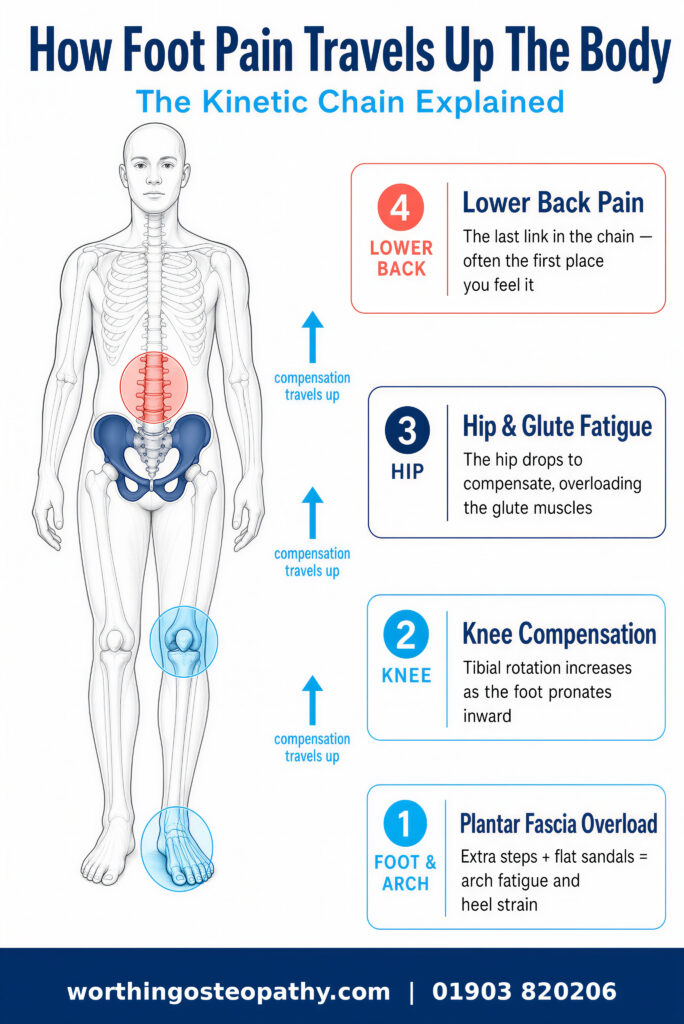
Every time your foot lands, it absorbs and redistributes the forces travelling through your body. When your feet are coping well, you barely notice this happening—it’s an automatic, background process your body handles thousands of times a day. But when the tissues become overloaded after thousands of extra steps, or aren’t getting much help from your footwear, those forces don’t simply disappear. Other joints and muscles further up the chain have to pick up the slack instead.
“In clinic, I often explain to patients that by the time they see me, their biggest complaint usually isn’t their foot at all—it’s their lower back or hip, compensating for days of overworked foot muscles,” says Sue.
Summer is the one season where many people accidentally remove that shock absorber without even realising it. When you wear unanchored shoes—like backless slides, fashion sandals, or loose flip-flops—your foot has to adapt in order to keep the shoe attached:
Unconscious Toe-Gripping: Many people subconsciously grip with their toes to help keep the sandal in place with each step. Over thousands of extra steps along Worthing Pier or Splash Point, those small muscles can become tired and irritated.
Loss of Cushioning: Thin canvas pumps or flat rubber flip-flops transfer more of the shock of every step straight into your heel bone, increasing strain on the tissue there.
Up-Chain Compensation: Some people begin to alter the way they walk as their feet become tired. This can alter the way your body moves and the forces travelling through your knees, hips and lower back. Over time, those changes may contribute to aches and stiffness elsewhere, particularly if you’re spending several hours on your feet each day.
“If your back suddenly hurts after a holiday, don’t automatically assume your back is where the problem started,” Sue adds. “It’s very often the last part of the chain to complain, not the first.”
Common Summer Foot Symptoms Explained
Why does my heel hurt first thing in the morning?
That sharp, stabbing sensation during your first few steps out of bed is a classic sign of plantar fascia overload. The plantar fascia is a thick band of tissue running along the sole of your foot, from your heel to the base of your toes, and it plays a key role in supporting your arch with every step.
On holiday, this tissue is often asked to do far more work than usual—more steps, harder surfaces, and less support from flat sandals all add up. Overnight, while you rest and the foot is off-loaded, the tissue tightens and shortens slightly. The very first steps of the day suddenly stretch it back out again, which is why that initial pain is often the sharpest of the whole day and tends to ease slightly the more you move.
If this pain has built up gradually over several days of holiday walking, rather than appearing after one specific incident, that’s a good sign that footwear and step-count are the main drivers—and that a few adjustments could bring real relief. If it doesn’t settle, it may be worth a heel pain treatment assessment.
Why do my calves suddenly feel tight after wearing sandals?
Many summer sandals are completely flat, with no heel lift at all. If you spend most of the year wearing shoes with even a subtle heel, running trainers, winter boots, or work shoes, your calf muscles and Achilles tendon become used to sitting in a slightly shortened position.
Switch overnight to flat sandals, and that same muscle-tendon unit is suddenly placed under constant extra stretch, step after step, for hours at a time. It’s a bit like doing a long, unplanned calf stretch every single day of your holiday without any of the usual gradual build-up. For some people this shows up as tightness; for others it can translate into a dull ache behind the ankle or mild Achilles irritation by the end of the week.
Why does my back ache after a long summer walk?
When your feet become overloaded and lose some of their natural arch support, your body instinctively adjusts your posture to keep you balanced and upright. This can alter the way your body moves and the forces travelling through your knees, hips and lower back.
Over the course of a single walk this barely registers. But repeated over several hours on a concrete seafront path, or across multiple days of a city break, those small changes may contribute to aches and stiffness elsewhere—particularly if you’re spending several hours on your feet each day. It’s a good example of how a problem starting at foot level can quietly work its way up the entire kinetic chain, and it’s one of the reasons our back pain treatment often starts with a look at footwear and gait.
The 10-Second "Twist Test"
You don’t need to wear heavy winter boots on a hot summer day. But before you head out for a day trip or pack your holiday bags, give your summer shoes this simple test:
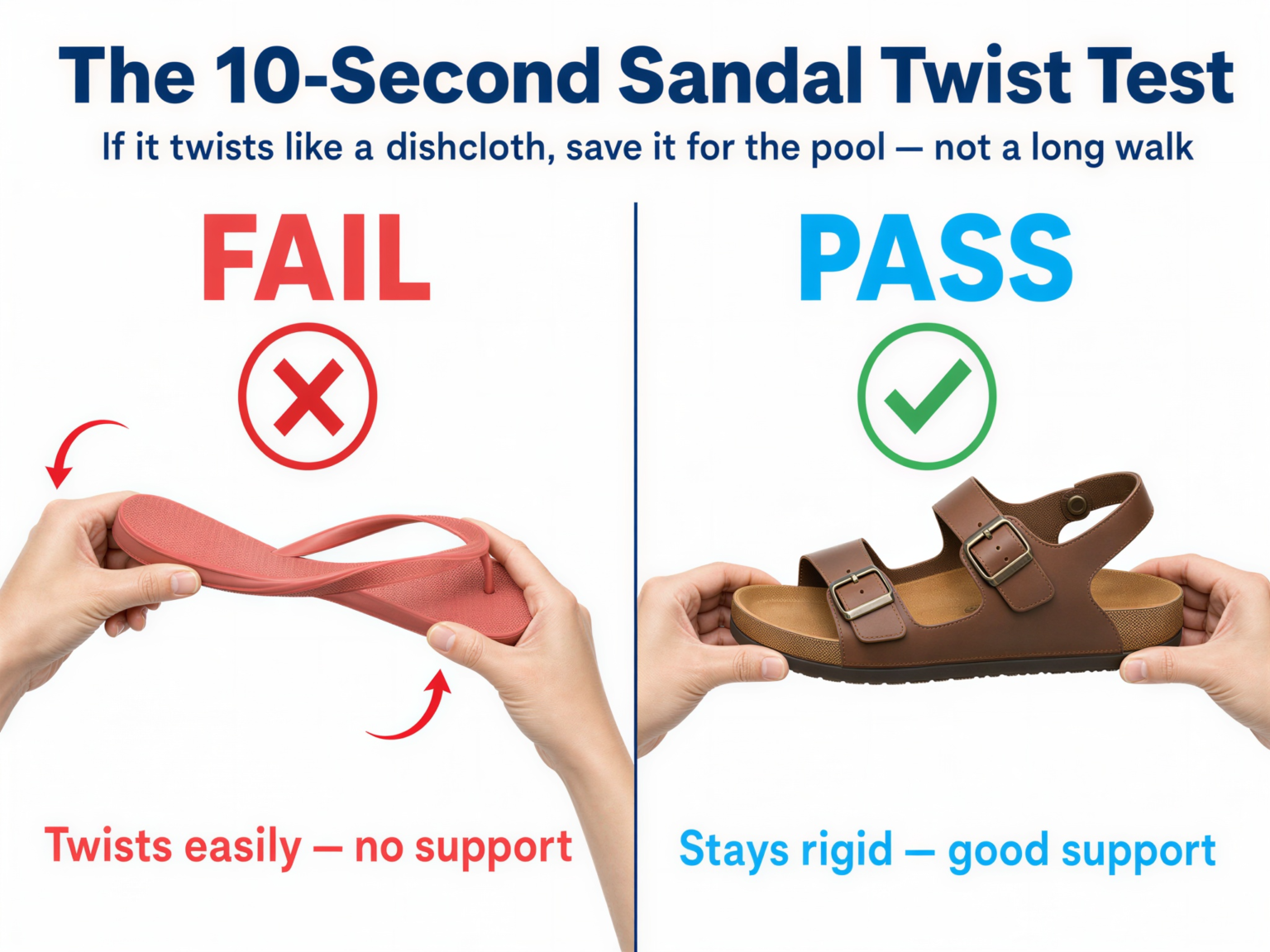
Hold your sandal at the toe and heel, then try to twist it.
If your sandal twists as easily as a wet dishcloth, it offers very little support for prolonged walking. It’s not a scientific test, but it’s a quick way of thinking about whether your footwear is designed for lounging by the pool or walking six miles around a city. Save the flimsier pairs for short trips to the pool or beach, and choose a shoe with a contoured footbed and a rear ankle strap for longer walks.
3 Simple Exercises to Relieve Tired, Overworked Feet
These exercises won’t cure every cause of foot pain, but many people find them helpful after a day of increased walking.
The Frozen Water Bottle Roll (3–5 minutes while seated): If the tissues under your foot feel sore after a day of walking, rolling your arch over a frozen plastic water bottle combines gentle massage with cooling. Many patients find it soothing after long days sightseeing, particularly if they’ve spent hours on hard surfaces like promenades or airport floors.
The Two-Part Calf Stretch (Hold for 30 seconds per leg): Because flat sandals place extra stretch through the calf and Achilles all day, a targeted stretch in the evening can help the tissue settle back to its normal length. Stand facing a wall with one foot back and heel flat. Keep the back leg straight to target the main calf muscle, then bend the back knee slightly to reach the deeper tendon nearer the ankle.
Towel Scrunches (10 scrunches per foot): If unanchored sandals have had your toes gripping all day, this exercise helps retrain those same muscles in a controlled way rather than an unconscious one. Place a small hand towel on the floor and use your toes to scrunch it toward you while seated—it restores healthy strength and control to the small muscles of the foot. A sports massage can also help if the muscles feel particularly tight or overworked.
When Isn't It Just Tired Feet?
While mild strain often improves with rest, ice, and supportive footwear, you should seek a professional clinical assessment if you experience any of the following:
- Pain lasting longer than two weeks without improvement.
- Significant swelling, redness, or heat around the heel or ankle.
- Numbness, tingling, or burning sensations in your toes or foot.
- An inability to bear weight comfortably.
- Pain that follows a slip or fall on uneven ground or pebble beaches.
- Symptoms that recur every single summer when you change footwear.
Frequently Asked Questions
It can certainly contribute to it. Plantar fasciitis develops when the band of tissue under the foot becomes overloaded and irritated, and a sudden jump in daily steps—especially in unsupportive footwear—is exactly the kind of change that can trigger it. It’s rarely the walking alone; it’s the combination of more steps, harder surfaces, and less support all at once.
Not necessarily. Complete rest isn’t usually the answer, but reducing your daily distance, choosing more supportive footwear, and adding in the exercises above can help the tissue settle. If the pain is severe, stops you putting weight through your foot, or doesn’t improve after a week or two of easing off, it’s worth having it looked at rather than pushing through.
Many podiatrists and osteopaths do recommend sandals with a contoured footbed and a proper heel strap, as they tend to offer more structure and arch support than flatter, backless alternatives. That said, no single shoe suits every foot, and the “twist test” above is a useful way to judge any sandal you’re considering for a long day on your feet.
Indirectly, yes. Sandals themselves don’t cause back pain, but a lack of support or cushioning can change the way your feet cope with extra walking, and that change can travel up through the knees, hips and lower back over time.
There’s no single number that applies to everyone, as it depends on your usual activity levels, footwear, and the surfaces you’re walking on. As a general principle, a gradual increase over the course of a holiday tends to be far kinder to your feet than doubling or tripling your usual step count in a single day.
If your symptoms are severe, are getting worse rather than better, are stopping you enjoying your holiday, or are accompanied by swelling, numbness, or difficulty bearing weight, it’s worth booking an assessment rather than
Get Back on Your Feet in Worthing
Summer should leave you with happy memories—not a sore heel that lingers into September.
“Sometimes a few simple changes to footwear, walking habits or movement patterns are enough to make a real difference,” says Sue Potten, our Chiropodist. “If your symptoms aren’t improving—or they’re stopping you enjoying your summer—we’d be happy to help.”
At Broadwater Osteopathic Practice in Worthing, our osteopaths evaluate your complete movement pattern—from your feet right up to your spine—to resolve the root cause of your pain.
To book an assessment, call us on 01903 820206 or visit our clinic at 2 Sompting Road, Worthing. You can also book an appointment online.


